
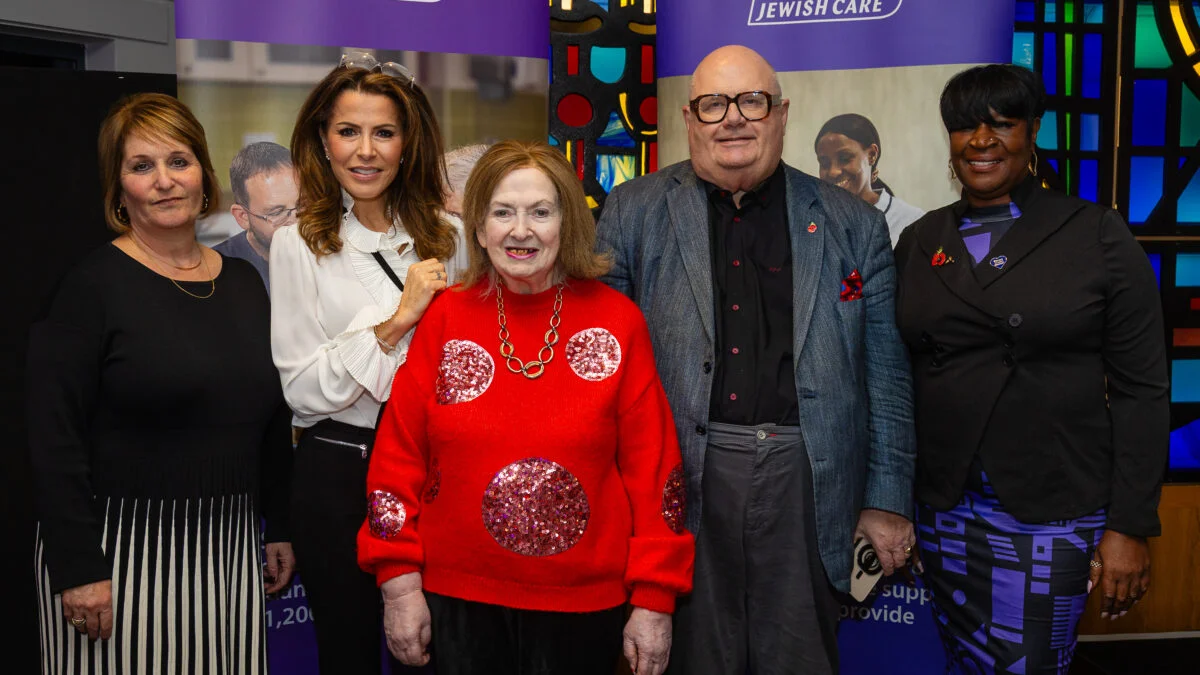
Natasha Kaplinsky OBE, newsreader, TV presenter and journalist, was in conversation with Lord Pickles, the UK Special Envoy for Post-Holocaust Issues, at an evening attended by 120 guests to raise funds for Jewish Care’s Sidney Corob House, a care home for people with enduring mental health needs.
Sandra Saintus, who has dedicated 35 years to Jewish Care and now serves as the Mental Health Services Registered Manager at Sidney Corob House and Jack Gardner House, made an appeal. The homes support members of the community with long-term mental health conditions, including schizophrenia, bipolar disorder, personality disorders and clinical depression. Some residents also have learning or physical disabilities, and many are now ageing.
Speaking at the event which took place at Jewish Care’s Betty and Asher Loftus Centre, Sandra said, “Despite the difficulties our residents face, our home is a warm and lively place, and our wonderful staff focus on a positive, can-do approach. The additional therapies, activities and outings funded by the Friends of Sidney Corob House are vital to our residents, and our deepest thanks go to the committee for their continued support.
“The Jewish community is privileged to have this service for those living with mental illness. Your support is more important than ever, especially as Jewish Care is now facing the impact of the increase in National Insurance, which will cost the organisation an extra £1.1 million this year. These extra funds are greatly appreciated and make a world of difference to our residents and their families, who tell us that the support in our homes is literally lifesaving.”
Sandra introduced resident Glenda Collins who walked up to her 1960s hit single Lollipop, saying, “We are truly blessed to be able to support you, Glenda, and we are privileged to have such a star with us at Sidney Corob House.”
Glenda Collins, shared her amazing story with guests:
“I’ve lived at Sidney Corob House for five years. Later in my life, I became ill with mental health problems. Living on my own wasn’t good for me — it made my mental health worse, and I became a lot more unwell. After moving to the home, I quickly found that being around people, where everyone talks to me and supports me, has really helped me and my mental health is a lot better. The care team are kind, good and caring. I feel I’ve got my life back.”
“I am a professional singer. It all started when I was 11 years old. I was on holiday in Bournemouth with my parents, Anne and Eric — G-d rest their souls. We met my future singing teacher, Anne Stephanie, and her husband William, who was a showbiz agent. I had lessons with Anne; I would sing and she would accompany me on the piano. They added me to their stable of stars, which led to me performing in cabarets and at a barmitzvah, alongside famous comedians and actors of the time, like Stubby Kaye and Alfred Marks. My father became my manager, and he was wonderful.
“When I was 16, we recorded two songs in the studio and I was signed to Decca Records. I was introduced to Joe Meek, the independent record producer behind the number one hit Telstar by The Tornadoes. I recorded Lollipop with him — it was a big song and a big success.
“Next, I appeared on Jukebox Jury in the hotseat with Brian Epstein and Cilla Black on the panel. Cilla thought the record would be a hit because everyone was tapping their feet. I was also on the bill for a Sunday concert in Great Yarmouth with The Beatles. My late father told me that John Lennon asked me to a party — but I don’t remember it!
“I went on tour in Scandinavia with Cliff Richard and The Shadows, accompanied by my late mother. The tour was a big success. I appeared on the front page of the Evening Standard, and had many TV appearances with Decca Records. I also flew to Ireland to appear on TV with Shirley Bassey. The ’60s was an amazing time!”
Glenda lived in London for most of her life, although she and her family lived in South Wales for 20 years while her husband, who was inducted by the late Chief Rabbi Lord Jakobovits, served as a Reverend in the Swansea Hebrew Congregation. She has two wonderful children and two gorgeous grandchildren.
Reflecting on life at Sidney Corob House, she said, “I’ve made really good friends here. We love spending time together — going for walks, going out for dinner, chatting — and I enjoy the poetry reading group. I didn’t talk much about my singing career during my first couple of years here, but during the pandemic my record producer got in touch about making a second album. I spoke to Sandra and, with her support, we recorded it at Sidney Corob House.
“We released Second Chance, two years ago, and to celebrate the album and my birthday Sandra arranged for us to go in a pink limo to tour the West End and see the lights – with the support of the Friends of Sidney Corob House Committee. I want to thank everyone for all their support and care”
After Glenda’s speech, Natasha Kaplinsky OBE said, “Glenda, you are a superstar! Mental health is at the forefront of our minds now — it’s so important to talk about it and to donate. I’m so pleased to support Jewish Care and the work of caring staff like Sandra, who support the residents at Sidney Corob House.”
Lord Pickles then interviewed Natasha Kaplinsky, asking about her growing up in Kenya, her broadcasting career, and her appearance on Strictly Come Dancing. They also discussed Who Do You Think You Are? in which Natasha discovered that her father’s relatives were murdered by the Nazis in the Holocaust. As a member of the UK Holocaust Commission, Natasha conducted 112 interviews with Holocaust survivors, preserving their stories for future generations, and subsequently received an OBE. Their conversation also covered her roles as President of Barnardo’s, and supporter of the British Film Commission, before taking questions from guests.
At the end of the evening, Jewish Care CEO Daniel Carmel-Brown said, “I’d like to thank Natasha Kaplinsky and Lord Pickles for so generously giving their time to support Jewish Care’s Sidney Corob House, as well as our guests for their support this evening. I would also like to thank the Friends of Sidney Corob House Committee for their hard work and dedication — not just tonight but throughout the year — in supporting the extra activities that make such a difference to residents’ wellbeing. At a time when we are facing significant economic challenges, these funds help provide extra creative, therapeutic activities and stimulating outings that enhance the everyday lives of our residents living with enduring mental health needs.”